Stranger Things Alphabet Wall PCB Badge
Categorie
Source
Open Source
Description
About The Project
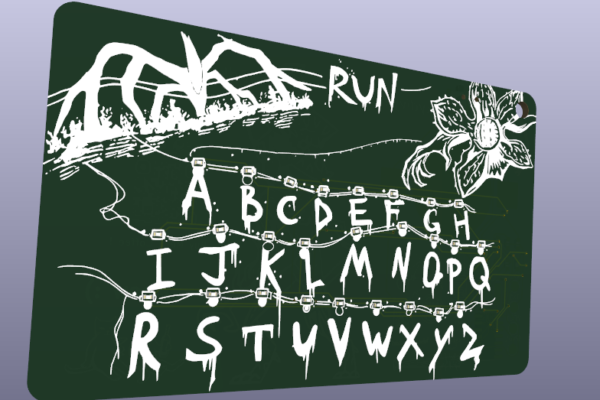
This project is a fusion of pop culture fandom and electronics engineering, manifesting as a custom-designed Printed Circuit Board (PCB) badge. It is a miniature, functional recreation of the “alphabet wall” used by Joyce Byers to communicate with the Upside Down in Stranger Things.
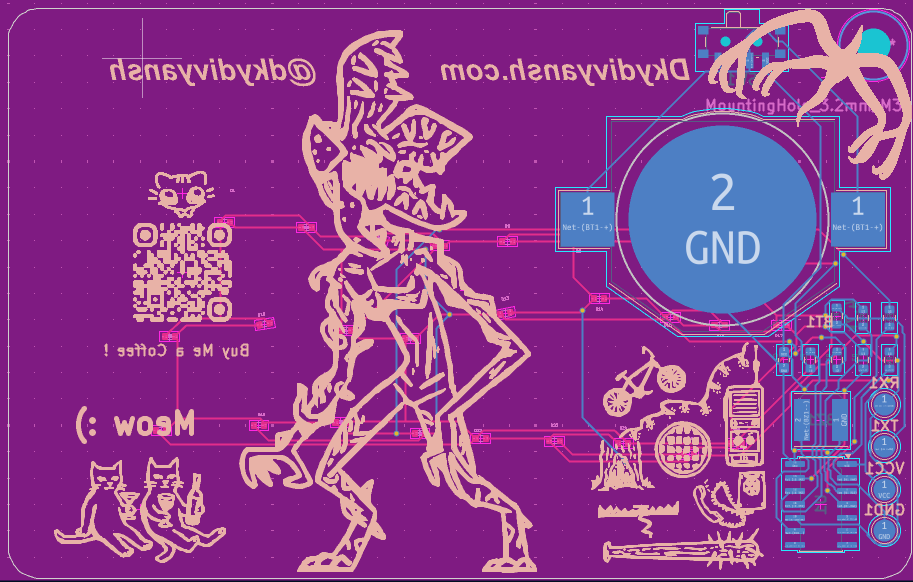
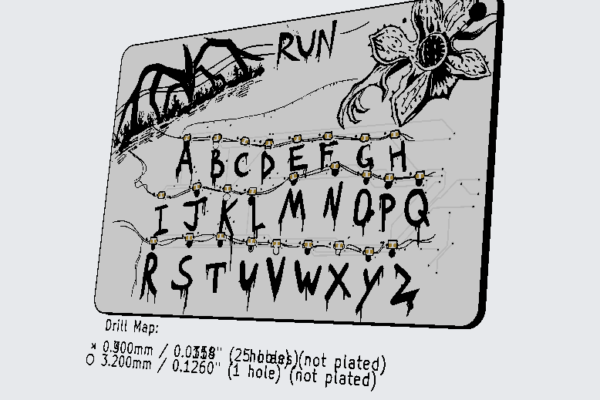
The PCB is not just a circuit carrier; it is the canvas. It features hand-drawn artwork rendered in black silkscreen on a white soldermask, depicting the A-Z alphabet, the towering Mind Flayer, and the Demogorgon flower. Underneath the art lies an embedded system capable of lighting up individual letters to spell out messages, just like in the show.
Features
- Artistic PCB Design: Custom high-contrast silkscreen art serving as a collectible prop or wearable badge.
- Full Alphabet Control: 26 individually controllable LEDs corresponding to letters A-Z.
- Integrated Sound: A piezo buzzer for eerie sound effects and feedback.
- Portable Power: Runs on a compact battery cell with a simple on/off slide switch.
- Efficient Circuitry: Uses advanced multiplexing techniques to minimize component count.
Hardware Overview
The heart of the badge is a modern, efficient 8-bit AVR microcontroller. Despite having a limited number of pins, the design controls 26 LEDs individually through a technique called Charlieplexing.
Key Components
- Microcontroller: ATtiny1614-SS (U1).
- LEDs: 26x Surface Mount LEDs (Mixed colors: Red, Green, Blue, Yellow).
- Audio: Piezo Buzzer (BZ1).
- Power: Battery Cell (BT1) controlled by an SPDT slide switch (SW1).
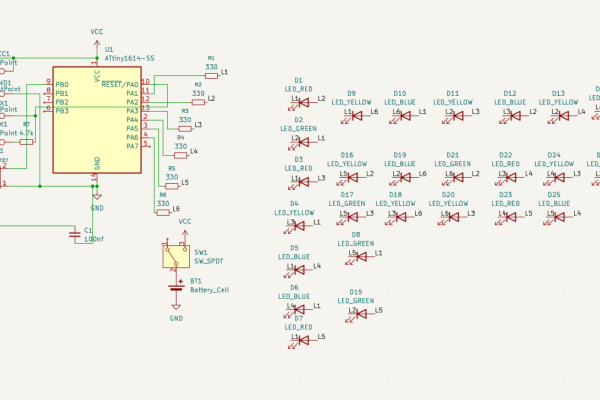
How Charlieplexing Works: To control 26 LEDs using only a small microcontroller, this design utilizes Charlieplexing. As seen in the schematic, 6 GPIO pins from the ATtiny1614 (PA1 through PA6) are connected to six lines (L1-L6) via 330-ohm current-limiting resistors (R1-R6).
The LEDs (D1-D26) are connected in opposing pairs across these lines. By rapidly switching the state of the microcontroller pins between High (VCC), Low (GND), and High-Impedance (Input), the firmware can target and illuminate any single LED at a time. By cycling through desired LEDs quickly, persistent vision creates the illusion that multiple lights are on simultaneously.
Explore More
Explore More
Explore More
Explore More
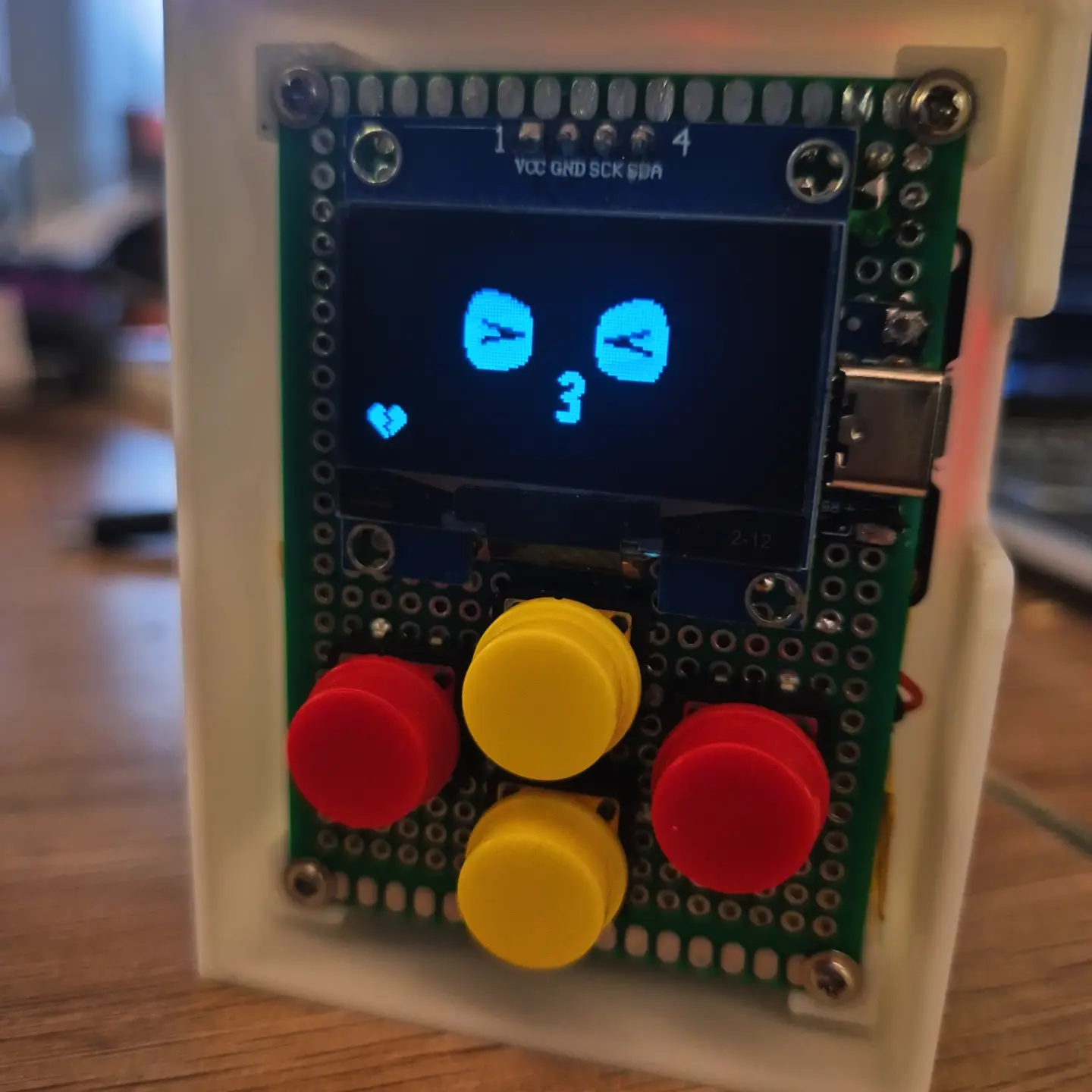
BMO [Desk-Pet + Retro Console]

SST Hub
Centralized SSO Server
Emily AI