Table of Contents
How does it work?
The Core Principle: Accelerating Ions for Thrust
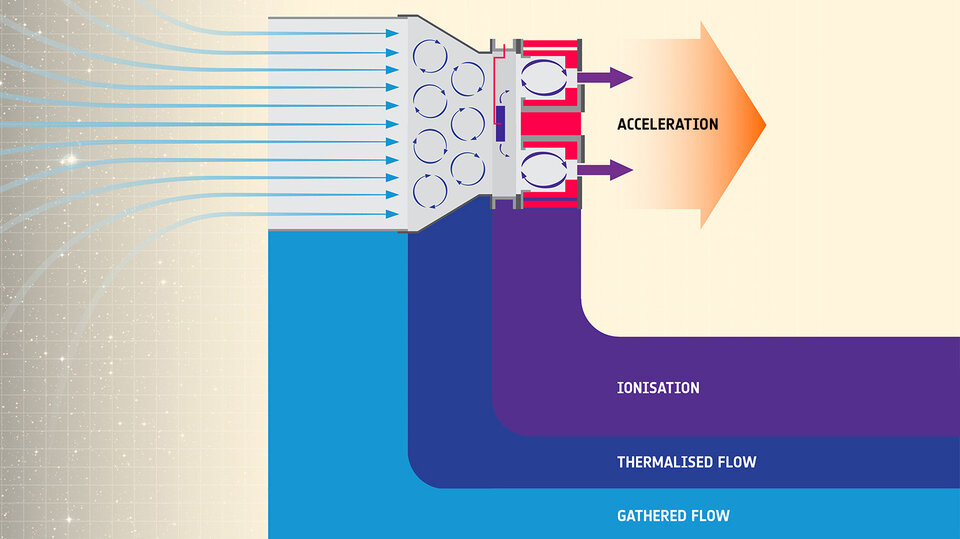
The fundamental principle behind ion propulsion is the generation of thrust by expelling a stream of ions at extremely high velocity. An electrical source is used to strip electrons from the atoms of a propellant, turning them into positively charged ions. A powerful electric or magnetic field then accelerates these ions and ejects them at high speed. This stream of exiting ions pushes the body in the opposite direction, providing a gentle but constant acceleration.
How It Creates Thrust
This type of ion propulsion, often called an electrohydrodynamic (EHD) thruster, operates by using the surrounding air as its propellant.
- Ionization of Air: The system uses two main electrodes: a very thin, sharp wire (the emitter) and a larger, smoother surface (the collector). A very high voltage is applied between them, creating an intense electric field around the sharp emitter. This field is strong enough to strip electrons from air molecules (mostly nitrogen and oxygen), turning them into positively charged ions.
- Creating Thrust (Ionic Wind): These newly created positive ions are immediately and strongly repelled by the positive emitter and attracted to the negative collector. As they surge through the air, they collide with billions of neutral air molecules, transferring their momentum and dragging them along. This bulk movement of air is called an “ionic wind,” and it’s this continuous, silent flow that produces thrust.
Operational Characteristics
The system’s primary strengths are its solid-state design and silent operation, with no moving parts. it is highly reliable and experiences less wear. A key benefit is its ability to use ambient air as a propellant, which eliminates the need to carry onboard fuel. However, these advantages are balanced by significant limitations, including a very low thrust output that makes it unsuitable for heavy-lift applications and the need for a heavy high-voltage power supply. Furthermore, its reliance on air means that for operation in a vacuum, it would require an onboard propellant source, negating a core advantage of the atmospheric design.
How to make Ion Propulsion model (basic)
High-Voltage Power Supply
A high-voltage power supply (HVPS) is an electronic circuit or device that converts a low-voltage input into an extremely high-voltage output. Unlike standard power supplies that provide common voltages like 5V or 12V, an HVPS is designed to generate outputs ranging from a few thousand volts (kilovolts, or kV) to millions of volts, all while typically providing very low current for safety and operational reasons.
Why Ion Thrusters Need High Voltage
A high-voltage power supply (HVPS) is the key of an atmospheric ion propulsion system. Its role is twofold to create the charged particles necessary for propulsion and then to accelerate them with immense force.
First, high voltage is required to achieve the dielectric breakdown of the atmospheric medium, which is normally an electrical insulator. By applying a kilovolt-level potential to a sharp emitter electrode, an intense electric field gradient is formed. This field is powerful enough to strip electrons from air molecules in a process known as corona discharge, generating a localized plasma.
Second, this same high-voltage potential creates the powerful electrostatic force needed for acceleration. The newly formed positive ions are forcefully repelled from the positive emitter and drawn towards a negative collector. This acceleration drives a continuous momentum exchange with neutral air molecules, resulting in the “ionic wind” that produces thrust. Without the high voltage, neither the initial ionization nor the subsequent acceleration would be possible.
HVPS Circuit
Converting a low-voltage DC source, such as a 5V battery, into the 40kV or more required for ion propulsion is a sophisticated multi-stage process. A typical HVPS circuit accomplishes this through a systematic voltage escalation.
The process begins with DC-AC inversion. A high-frequency oscillator circuit converts the stable low-voltage DC input into a pulsating or alternating signal. This high-frequency AC is then fed into the primary coil of a flyback transformer, a specialized component designed to step up voltage dramatically. The transformer’s output, now in the kilovolt range, is still not high enough.
For the final boost, the transformer’s output is passed through a cascade voltage multiplier, such as a Cockcroft-Walton generator. This circuit uses a ladder of diodes and capacitors to progressively multiply the voltage with each stage, efficiently elevating it to the final target potential required for propulsion.
In this build, I created a circuit to convert 3-6V to approximately 40kV using a Step Up Power Module. You can also buy – https://robu.in/product/400kv-step-up-power-module and USB Type-C PD Decoy Module – https://robu.in/product/pd-qc-afc-fast-charge-decoy-trigger/
Ion Propulsion
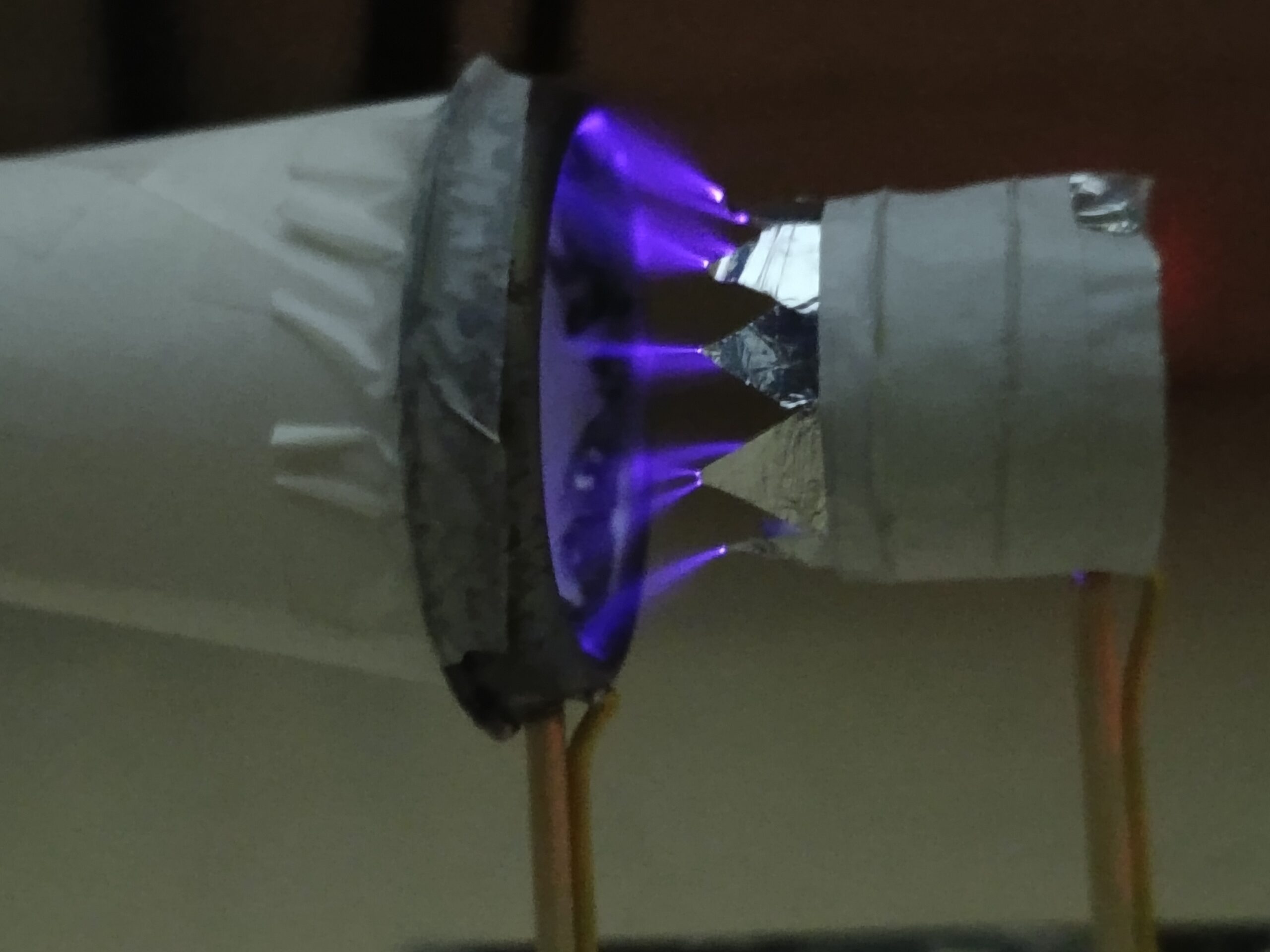
The Annular Foil Emitter: The front, serrated ring, fabricated from aluminum foil, functions as the positive electrode or emitter. The strategic incorporation of sharp, tooth-like points along its circumference is a critical design choice. These points serve as highly localized sites for electric field intensification, significantly enhancing the efficiency of the ionization process through corona discharge.
The Cylindrical Foil Collector: Positioned behind the emitter, the smoother, wider ring, also constructed from aluminum foil, acts as the negative electrode or collector. Its larger, continuous surface area provides an optimal target for the accelerated ions, facilitating efficient charge collection. The distinct geometric and potential difference between the sharp emitter and the smooth collector is paramount for establishing and maintaining the stable electric field required for operation.
Ionization via Corona Discharge
When a high-voltage differential is applied, the electric field strength at the sharp points of the foil emitter surpasses the dielectric strength of the ambient air. This initiates corona discharge, a process where electrons are stripped from atmospheric molecules (primarily nitrogen and oxygen), creating a localized plasma of positively charged ions. The characteristic purple luminescence is a byproduct of these high-energy molecular interactions.
Electrostatic Acceleration
The generated positive ions are then subjected to a powerful electrostatic force. They are strongly repelled by the positively charged emitter and concurrently attracted to the negatively charged collector. This force accelerates the ions rearward through the inter-electrode gap.
Thrust Generation through Momentum Exchange
As these high-velocity ions traverse the gap, they undergo numerous inelastic collisions with neutral air molecules, transferring kinetic energy and momentum. This bulk movement of charged and neutral particles constitutes the ionic wind, which, by action-reaction principles, generates a forward thrust on the device.
Optimized Design for Directional Propulsion
This annular, dual-foil ring design represents a significant step towards practical atmospheric ion propulsion. By concentrating the electric field at multiple points along the emitter ring and shaping the flow path, the design effectively focuses the ionic wind into a more coherent and directed jet. This contrasts with simpler, flat-panel designs that tend to produce more diffuse lift. Such a focused output is crucial for applications requiring precise directional control and greater propulsive efficiency.
Conclusion and Future Outlook
This project successfully demonstrates the principles of electrohydrodynamic (EHD) propulsion with a novel and effective annular thruster design. By carefully engineering the geometry of the foil emitter and collector, we have observed the direct conversion of high-voltage electrical energy into kinetic thrust, visually confirmed by the characteristic corona discharge. This model serves as a tangible and powerful illustration of complex physics, proving that the foundational concepts of silent, solid-state propulsion are accessible through hands-on experimentation.
Looking forward, this technology, while low in thrust, holds significant promise in several niche applications. The silent, vibration-free operation makes it a compelling candidate for developing stealthy silent drones or for localized air-moving systems in thermal management to cool sensitive electronics without fans. In aerospace, similar principles are being researched for active flow control over wings to reduce drag and improve flight efficiency.
Further experimentation with this design could involve optimizing the emitter-to-collector gap, altering the number and sharpness of the emitter points, or testing different materials to improve the thrust-to-power ratio.
A final, critical note on safety: These experiments involve lethal high-voltage potentials. All work should be conducted with extreme caution, proper insulation, and a thorough understanding of the risks involved.